Australian households have installed as many home batteries in the six months to the end of last year, as they did across the previous five years combined, as families and business strive towards energy independence, reducing energy bills and setting a new record for home battery installations, new research reveals.
The Clean Energy Council’s bi-annual Rooftop Solar and Storage Report (Jul-Dec 2025), shows more than 183,245 battery units were sold in the second half of 2025 alone – a four-fold increase compared to the same period in 2024. This is equivalent to 99 per cent of sales made between 2020 and 2024 and brings the total number of battery installations across Australian households to 454,753 as at the end of last year.
Our biggest power station now resides on the rooftops of more than 4.3 million households, which is helping to drive downward pressure on power bills for consumers and businesses, with less reliance on expensive gas or unreliable coal to power our grid.Jackie Trad Clean Energy Council CEO
Overall, Australia’s share of rooftop solar continued to increase its contribution to the nation’s electricity supply last year, making up 14.2 per cent of the energy supplied to the grid in 2025 and almost doubling over the last five years since 2020, when it was at 7.2 per cent.
The report reveals Australians installed 2.6 GW of new capacity on their rooftops during 2025 – just short of the capacity of an Eraring coal-fired power station (2.9 GW), the largest in the country. Among the states and territories, New South Wales continues to lead the nation’s rooftop solar installed capacity (8 GW), while Queensland continues to lead in the number of installed systems (1.16 million).
We’ve seen phenomenal uptake of home batteries in Australia, with installations more than doubling in the space of one year. This increase in demand has also driven a surge in new batteries and inverter products available in the market, giving customers more choice than ever.Jackie Trad Clean Energy Council CEO
Jackie Trad, Clean Energy Council Chief Executive, said that while these achievements are a testament to incentives such as the Federal Government’s Cheaper Home Batteries program, launched in July, in tandem with other state-based programs in New South Wales and Western Australia, they have expanded Australia’s long-standing love of rooftop solar.
"Our biggest power station now resides on the rooftops of more than 4.3 million households, which is helping to drive downward pressure on power bills for consumers and businesses, with less reliance on expensive gas or unreliable coal to power our grid,” Ms Trad said.
“Australia’s rooftop solar uptake is a national triumph and now accounts for 28.3 GW of installed capacity, eclipsing that of the country’s entire fleet of coal-fired generators (22.5 GW). It not only leads our national renewables rollout but also leads the rest of the world on a per capita basis.
“We’ve seen phenomenal uptake of home batteries in Australia, with installations more than doubling in the space of one year. This increase in demand has also driven a surge in new batteries and inverter products available in the market, giving customers more choice than ever,” she said.
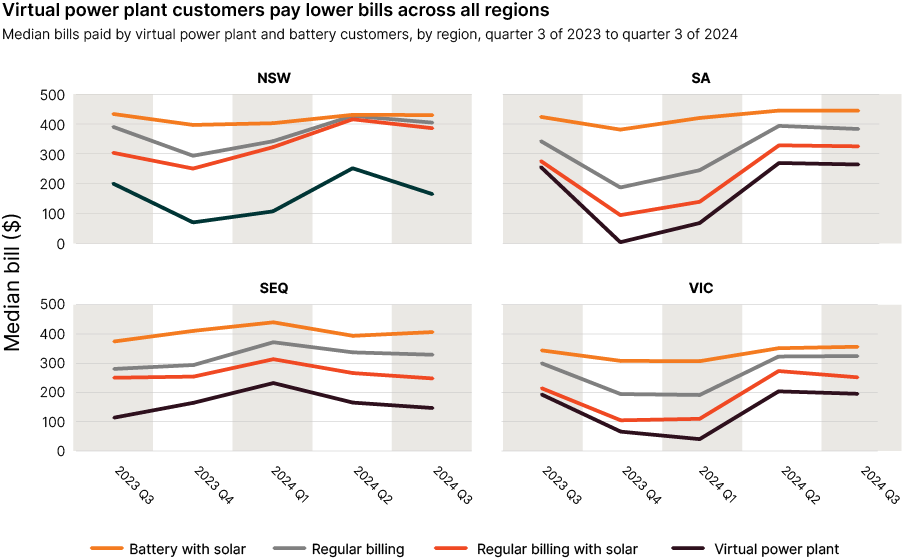
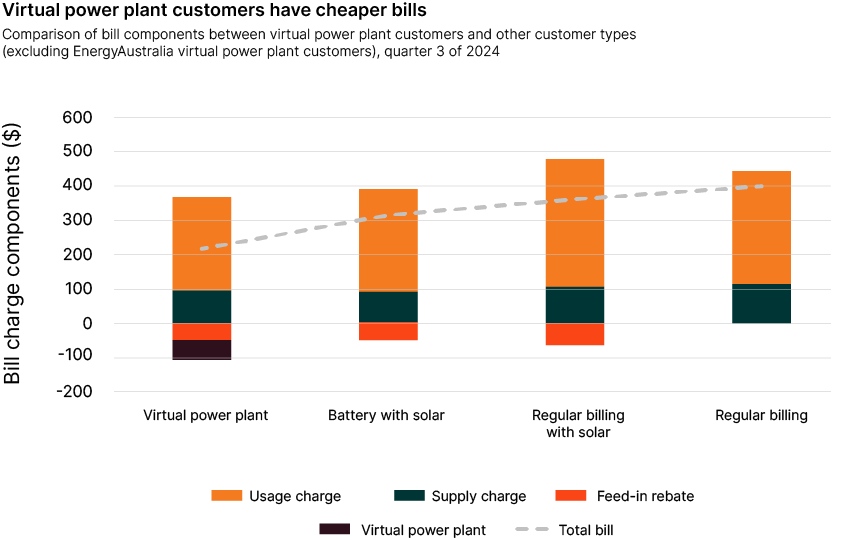
However, many households are not getting the full value of their solar and batteries unless they are part of a virtual power plant.
“We know energy customers who sign up to a Virtual Power Plant (VPP) are currently paying the lowest power bills in Australia, according to the most recent analysis by the ACCC. That’s why encouraging and incentivising stronger participation in VPPs by Australian households and businesses is more important than ever,” she said.
The ACCC’s Inquiry into the National Electricity Market report (July 2025) found that households with rooftop solar and a battery pay on average $323 per quarter for their energy bills but can save an additional $106 if they are signed up to a VPP, bringing them down to $217 per quarter on average (Figure 1 & 2).
By participating in a VPP program, households can receive bill credits or higher feed-in-tariffs for sharing stored energy. VPPs help reduce peak demand, allowing households to use and share their excess stored energy, driving wider system cost savings for all energy users. By selling excess stored energy during high demand periods, households can also earn additional revenue. This reduces the payback period and leads to a faster return on investment for a solar battery system.
“This in turn helps reduce strain on the national energy grid during peak times, contributing to overall grid stability and reliability – it’s a win, win,” Ms Trad said.
“That is why it is critical industry and governments work together to raise greater consumer awareness, trust and understanding about the many benefits of participating in VPPs, which is the next step to driving consumer energy bills down even further,” she said.
ENDS
For more information or to arrange an interview, please contact:
Danielle Tricarico
Clean Energy Council General Manager - Media
Liam Straughan
Clean Energy Council Media Officer
+61 409 470 683
Latest news

Submission on strengthening Australia’s response to modern slavery in supply chains

Australians backing rooftop solar, home batteries in record numbers
Rooftop solar and storage report: January to June 2026

Australia's clean energy pipeline notches a big century in 2026

Reckless Coalition energy plan would take Australia backward