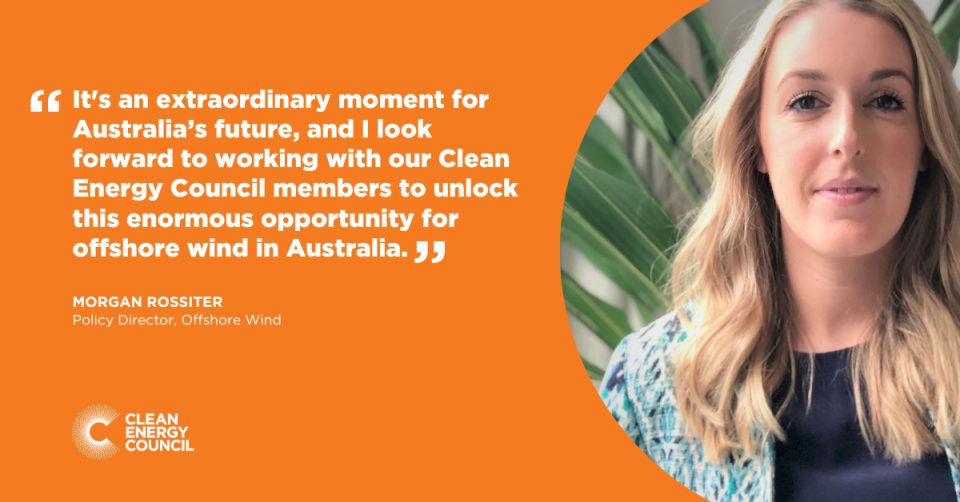
Clean Energy Council Appoints Morgan Rossiter As Policy Director For Offshore Wind
The Clean Energy Council is pleased to announce the appointment of Morgan Rossiter to the position of Policy Director for Offshore Wind.
Share this story
11 Sep 2023
Prior to her Clean Energy Council role as Senior Policy Officer in the Market, Investment and Grid policy team, where she focused on transmission access reform, Morgan previously spent over 10 years working in the oil and gas industry across Australia and Singapore. She brings her deep expertise in logistics, shipping, and large-scale infrastructure projects, as well as a Masters of Environment and Sustainability, a Bachelor of International Business (Logistics and Supply Chain), and professional certification from the Institute of Chartered Shipbrokers.Morgan says: ‘It’s an extremely exciting time for offshore wind in Australia. The pace and scale of growth is exceptional, but I see this as well-aligned with the opportunity to deliver clean electrons generated by our offshore wind farms into our grids.The next six months will be focused on ensuring we can elevate the voice of offshore wind in Australia, and ensure we are laying out a solid strategy to set the industry up for long term success.I am keen to bring my experience to the challenge of supporting the industry as it grows. Personally, this role is bringing together all my favourite things – the ocean, reducing emissions and really, really big ships. It doesn’t get much better!’
At the APAC Offshore Wind and Green Hydrogen Summit this August, Morgan moderated the panel discussion, 'Australia's Role in Driving Offshore Wind Growth in the Asia Pacific Region', an expertly run session with a focus on supply chains and the need for strong government leadership to drive offshore wind in Australia.
Morgan kept the conservations flowing along with panelists Matthew Dickie (RWE), Fernando Santamaria (Iberdrola), Henriette Holm (Orsted Australia), Eric Antoons (Parkwind) and Danny Nielsen (Vestas). Morgan’s succinct final question, 'What should we pause, stop and start', really had the panelists thinking.
Watch Morgan's key takeaways from day two of the summit in the video below.
Submission to NSW DCCEEW on changes to the Biodiversity Assessment Method
Our submission proposes a number of recommendations for changes to ensure the renewable energy sector does not face unintended consequences and challenges.
Submission to Industry-led Electricity Contract Co-Design Consultation Paper
The Industry Working Group released a September consultation paper on the contract structures to be procured under the Electricity Services Entry Mechanism (ESEM). In our submission, we welcome the fast, yet transparent and consultative process and the broad proposed package.
Submission on strengthening Australia’s response to modern slavery in supply chains
Our submission to the Attorney-General’s Department supports proposed reforms to the Modern Slavery Act 2018 (Cth) and provides recommendations on the design of the proposed ‘failure to prevent modern slavery offence’. It also includes renewable energy sector case studies highlighting practical supply chain challenges and considerations for implementation.
Australians backing rooftop solar, home batteries in record numbers
As conflict far from Australia’s shores drives up fuel prices and renews inflation pressures, households are increasingly taking energy security into their own hands.