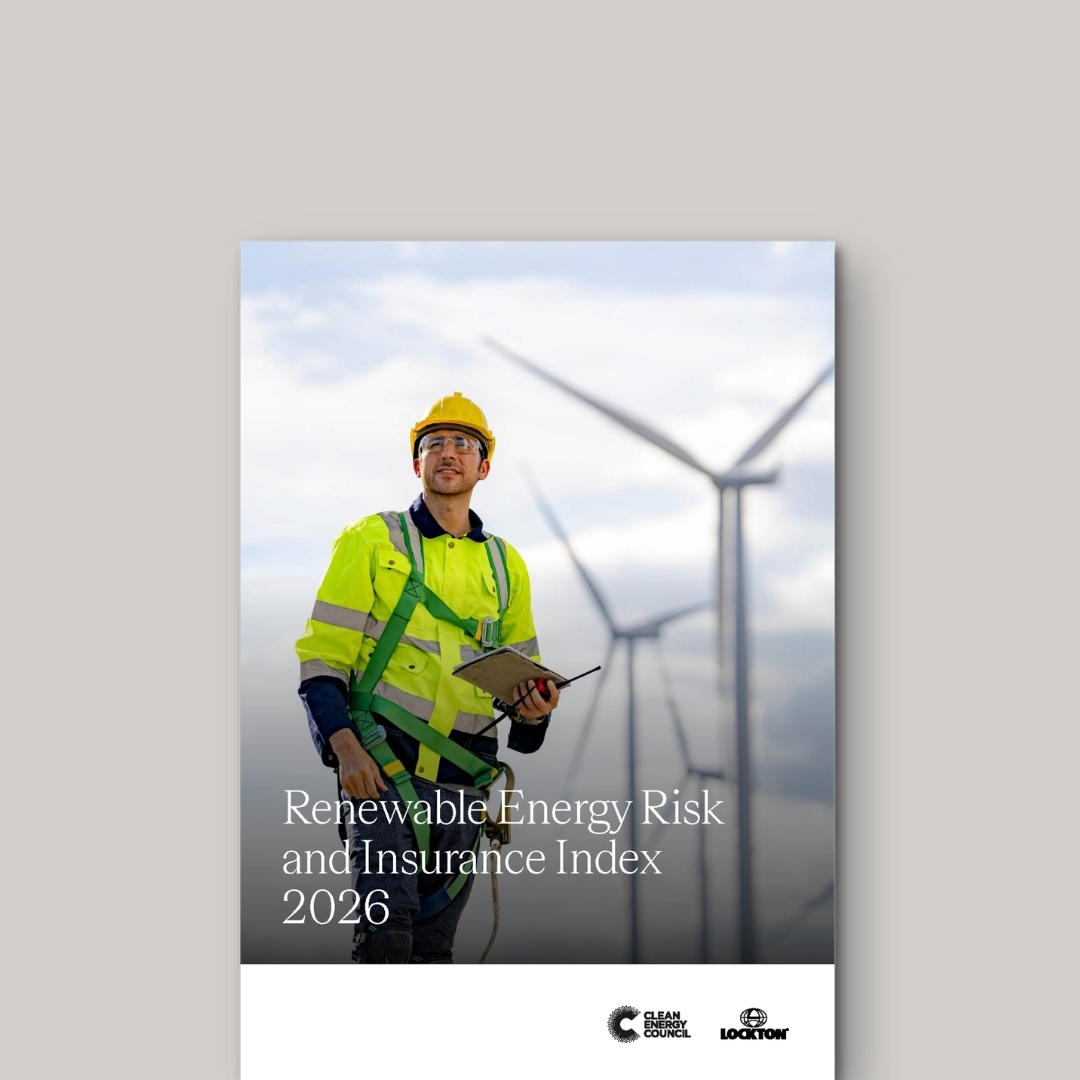
Renewable Energy Risk and Insurance Index 2026
Mapping the road to faster clean energy project delivery
Australia’s clean energy transition presents an enormous opportunity.
Realising it requires a clear view of the risks involved in ambition and delivery.
The shift from fossil fuels to renewable energy is one of the defining economic reforms of our time. It will shape how we power our homes and industries, and the prosperity and security we pass to the next generation. As the industry expands and matures however, new challenges are emerging.
The inaugural Renewable Energy Risk & Insurance Index, developed jointly by the Clean Energy Council and Lockton, captures the experience of more than 140 renewable energy developers, investors, operators and financiers. It provides a national benchmark of the risks facing Australia’s clean energy sector and identifies pathways to mitigate and resolve them.
Five key areas to unlock speed and scale
The findings from the Index reflect an increasingly complex operating environment for Australia's renewable energy sector, at a time when the country needs to accelerate investment to meet growing demand and maintain energy security.
The Index identifies five interconnected areas requiring action. They show governments and industry where to act and steps that can be taken to unlock the energy projects Australia needs.
-
1. Grid and transmission reform to connect new energy supply
What the Index found
Eighty-five per cent of respondents identified grid constraints, congestion and curtailment as the most significant growing operational risk, while 69 per cent said these risks were poorly addressed by current frameworks and insurance.
What’s needed
Faster delivery of Renewable Energy Zones and transmission projects, alongside continued reform through initiatives such as the joint AEMO and Clean Energy Council Connections Reform Initiative, can improve clarity and reduce connection risk.
-
2. Clearer, faster approvals, without lowering environmental standards
What the Index found
State planning and environmental approvals remain the largest opportunity to simplify project development. Eighty-one per cent of respondents rated state environmental approvals as difficult, and 71 per cent said they had become harder to obtain over the past three years.
What’s needed
Bilateral agreements between governments, risk-based conditions and better-resourced assessment agencies can create more coordinated, evidence-based and proportionate approval pathways while maintaining strong environmental outcomes.
-
3. A stronger workforce for a growing industry
What the Index found
Labour shortages were rated as both the most likely and most severe workforce risk, with consequences extending beyond recruitment to project schedules, safety and continuity of expertise.
What’s needed
A national approach to workforce capability can expand skills pipelines through education partnerships, broader recruitment and stronger succession planning.
-
4. Genuine and consistent partnerships with communities
What the Index found
Nearly three in four respondents said meeting community expectations had changed their approach to engagement, while 58 per cent rated engagement as difficult.
What’s needed
Clearer national guidance on benefit-sharing with local communities can build genuine and consistent community partnerships during project development.
-
5. Policy and market certainty to unlock investment
What the Index found
Sixty-nine per cent of respondents identified market and revenue volatility as a leading investment concern.
What’s needed
Ongoing refinements to policy settings, including energy market rules, Capacity Investment Scheme (CIS) tenders and the Safeguard Mechanism, to give investors certainty and reduce risk premiums and costs that ultimately get passed to consumers.
Turning momentum into delivery
The Index reveals an industry confident in the future and ambitious in its goals, while adapting to a more complex operating environment. Respondents made clear that we have the drive, technology and capital to meet Australia’s energy needs, but greater certainty and coordination are needed to convert that ambition into delivery.
Work is already underway. states and territories are progressing planning and approvals reform, national environmental law reform is moving forward, and industry and governments continue to improve grid connection processes and energy market settings.
The Index gives industry, governments, investors and insurers a shared evidence base to measure progress, identify emerging pressures and target the coordination, resilience and protection that projects need. Accelerating this work will help transform uncertainty into investment, infrastructure, jobs and prosperity.
“The message from industry is clear: certainty attracts investment, jobs and opportunity, and uncertainty slows these down. Giving industry the confidence to deliver the projects that will power Australia's future must remain a top priority.”
Renewable Energy Risk & Insurance Index 2026
Developed jointly by the Clean Energy Council and Lockton
To discuss what these findings could mean for your organisation’s risk strategy, contact the Lockton team.
.png)